
 Many diets have classified themselves as ‘detox’ diets. Such big differences between these ‘detox’ diets have lead to a phenomenon where the word ‘detox’ has practically lost its identity and has been associated with both positive and negative experience based on individual methods used. What many do not realize is that there is actually a great potential for harm when an unsafe protocol is followed.
Our bodies have an innate ability to detoxify some of the toxins we interact with. So why are we so toxic? Our exposure to various chemicals has been growing at an exponential rate and have become ubiquitous in our daily living. Several studies by The Environmental Group has identified a total of 167 chemicals in the blood and urine of the average individual. Some chemicals with preliminary evidence to support carcinogenic (cancer promoting) and neurotoxic (damage to the nervous system) potential in the body.
Part I- What are toxins?
This article will be the first of several in a series on detoxification. For the purpose of these articles, toxins will be defined as the cumulative affect of three elements: internal toxins, external toxins and toxic behaviours that negatively influence our detoxification system.
External Toxins
Environmental pollutants
Silver/mercury dental amalgams
Mercury contained in fish
Lead contained in old paints, blinds and canned goods
Aluminum contained in antiperspirant, deodorant, antacids
Constant mold exposure from improperly controlled rooms (basements, bathrooms, etc.),
Occupational exposure (Higher risk: miners, pottery artist, mechanics, pesticide exposure)
Poor air quality and sick building syndrome
Contaminated water, food
Inhalant smoke
Chemicals found in personal care products, household cleaners
Bisphenol A found in soft plastics
Phthalates
UV radiation
Internal Toxins
Chronic infections (chronic sinusitis, dysbiosis of the intestinal track)
Allergic reactions (immediate and delayed sensitivities)
Most common delayed type sensitivity (gluten, dairy, egg, corn)
Liver enzymes dys-balance
Medications
Long term use of tylenol is one of the leading causes of liver failure and prevents liver detoxification
Proton pump inhibitors (acid blockers) lead to subpar digestion and absorption of vitamins
Toxic behaviours
Dietary: Intake of trans fat, high fructose corn syrup, processed foods, refined flours
Excessive stress
Part II- Understanding the Basics: Our major detoxification organs
The liver, the kidneys and gastrointestinal tract via the gall bladder are the major detoxification organs. That’s right! You heard me, we have an innate ability to detox every single day without even thinking the word ‘detox diet’.
The Liver:
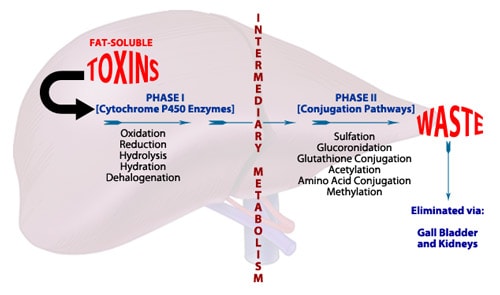
The liver is a crucial aspect of biotransformation of toxic compounds needed to be excreted. It uses a two step enzymatic process in detoxifying.
Phase 1- the liver:
Step 1:
The first phase enzymes (cytochrome pathways) starts the biotransformation by turning fat soluble toxins into an intermediate toxin. The problem is that this intermediate toxin is more hazardous to our bodies than the initial fat soluble toxin.
Step 2:
The second phase enzymes (conjugation pathways) finishes the job by taking hazardous intermediate toxin and turning into a water soluble toxin ready for phase 2 the excretion process.
Having a two step process leads to the potential of an imbalance. Think of the liver as a factory with two conveyor belts. If the first conveyor belt is creating garbage at rate greater than the second conveyor belt has the capacity to discard it, we are in some trouble! If phase 1 enzymes are working faster than phase 2 enzymes you are creating a buildup of toxic intermediate byproducts that can react and damage DNA.
These liver enzymes can be positively and negatively influenced by factors like certain foods, drinks and hormones we consume or produce. That means our diet can have an impact on the speed of these conveyor belts by either promoting a toxic intermediate build-up or promoting a synchronized balance.
Phase 2- the Gastrointestinal track and the kidneys:
Step 3:
The liver has now converted the toxins into a water soluble toxin ready for excretion into the kidneys and the gastrointestinal track via the gallbladder. Recent research has found that the receptors on the kidneys and gastrointestinal track, which allow the toxins to enter for excretion, are sensitive to pH. The physiology involved in this phase is quite complex, so here’s an analogy –The liver has transformed the garbage into a form (water soluble toxin) that is acceptable by the garbage truck in an environment (the right pH for excretion) that is acceptable by the garbage truck. The garbage truck is now moving along your gastrointestinal track to the ‘dump’. The difference is that in reality, your garbage truck is interacting with the billions of bacteria that exist in your digestive track. If your garbage truck is too slow or the ratio of healthy to unhealthy bacteria living in your gastrointestinal track is off, some of your garbage may get transformed by the bacteria into a form your body can reabsorb! That bacteria product would then need to travel trough the liver once again in order to be prepared for the dump yard.
Understanding the basics are an essential foundation in understanding how our actions can influence these pathways. Stay tuned for my next article on practical steps one can take to detoxify!

[…] understand the definition of a toxin and how our body’s detoxification pathways work please read my previous article. These are four practical steps one can take to live a more detoxified […]