
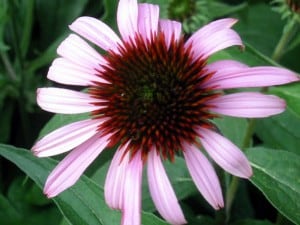
Photo credit: ©2005 Cyndi Gilbert
What is echinacea?
Echinacea is one of the most well-known and misunderstood herbs in North America. When one word can mean a plethora of different things being misunderstood becomes inevitable. Let’s explore.
Echinacea can vary by:
1. Species
- Echinacea angustifolia, Echinacea purpurea and Echinacea pallida
2. Different part of plant used
- Root , Whole plant, Flowering whole plant, Herb (aerial parts), Herb top (or Herb), Herb top flowering
3. Different extraction methods
- Extract and Pressed juice
The permutation of these four factors results in drastic differences between the phytochemical properties of the finished preparation. This is why echinacea preparations are not created equal and this in great parts explains the mixed results seen in the literature. Both positive and negative studies make huge headlines that spread wide and far. General echinacea headlines that from a general population perspective should and would confuse, isn’t echinacea always echinacea? Who knew there are so many variations? In much of the literature the preparations of echinacea are not or poorly defined by active phytochemicals and/or sub-therapeutic dosages are used. Without proper identification of the preparation and rational dosing, some of the research is of no value. A study by Wills (2008) compared the concentration of particular phytochemicals known to influence the immune system and confirmed huge variability between preparations.
What are we looking for?
There is some movement in the scientific world as to which phytochemical is most likely responsible for the immune modulating properties of this botanical. The latest research makes a strong case for the phytochemical alkylamides. It is the only phytochemical that has shown to possess all 3 following properties: alkylamides are bioavailable, demonstrate immunological activity in vitro studies and have been found in human plasma after ingestion. Echinacea with well defined quantities of alkylamides have been shown to reduce the intensity and frequency of colds & flu’s.
Echinacea defined.
1. Species
Of the three species of Echinacea commonly found, Echinacea purpurea has by far the greatest concentration of alkylamides, followed by Echinacea angustifolia. Echinacea pallida has negligible amounts of alkylamides. Although echinacea purpurea has greater amounts of alkylamides it is quickly metabolized while echinacea angustifolia has the capability to slow down the metabolism of the alkylamides found in echinacea purpurea. A study (Matthias, 2007) found that the combination of echinacea angustifolia and echinacea purpurea is best in order to increase overall bioavailability.
2. Different part of plant used
The root rhizome albeit more difficult and expensive to prepare has much more alkylamides than any other parts. Many inexpensive products neglect to use the root and opt for other plant parts despite comparatively negligible amounts of alkylamides.
3. Different extraction methods
A high-alcohol extraction process concentrates the lipophilic phytochemicals of the root resulting in a preparation with high levels of alkylamides. Pressed juice is obtained by a hydrophilic process that concentrates water-loving phytochemicals resulting in a preparation with low levels of alkylamides, and high levels of polysaccharides which, albeit having demonstrated immunological activity in vitro, has not been shown to be bioavailable in humans.
Coming full circle: from tradition to science and back
What is most fascinating is that the latest scientific findings are supporting the Native American tribes ways of preparing echinacea. They predominately use echinacea angustifolia and they exclusively used the root. Native Americans then prepared a fluid extract using high percent alcohol to extract the lipophilic (fat-loving) phytochemicals, this process ensuring high levels of alkylamides (Wagner, 1996). Most amazingly is what is found in their text written in 1905, prior to the scientific capacity to define individual phytochemicals. They wrote that a quality tincture would impart a tingly sensation in the mouth (Felter, 1905). What we know today is that alkylamides are responsible for imparting the tingly sensation in the mouth and is the most promising as the main immune modulating phytochemical, thus reinforcing what the Native American tribes had clinically witnessed.
Bottom-line
As a naturopathic doctor I’ve seen my share of eye rolling when I prescribe echinacea. Most patients are like, “really? I’ve tried that before”. My answer is that you haven’t likely tried echinacea from the right species, the right part, with proper extraction method at the proper dose and prescribed in an appropriate fashion. Echinacea is an herb that has amazed me clinically and that I have grown to love.
What’s has your experience been with echinacea? Have you ever experienced the tingly feeling on your tongue when taking a tincture? I’d love to hear your comments.
