• Skip to main content
  • Skip to footer

Naturopath in Burnaby and Virtual Care Across BC | Dr. Mélanie DesChâtelets, ND

  • About
  • New? Start Here
  • Current Patient
  • Refill
  • Blog
  • Contact
  • Book Now

Articles

June 2, 2011 By Dr Mélanie DesChâtelets, ND

My story

This is the most personal blog I have written thus far.  I wanted to take a step back from the usual content to properly introduce my story and the goal of this blog.  Many often wonder how one becomes a naturopathic doctor.  Let’s face it, most people pass much of life without really knowing what the heck one does, how to say it and especially what to expect from one!  Heck, even spell check doesn’t recognize the word.   Some of the preconceived ideas of what I do make me laugh, and well, if they didn’t make me laugh they would probably make me cry so I choose to laugh instead.  So how did I become one? I was raised by parents who were very involved with health.  My father, a world class and Olympic level wrestler knew the synergistic importance of both physical fitness and mental fitness to health and success.  My mother, an incredible teacher who was also a lifelong learner herself studying and reading all she could on health and nutrition.  This lead to the upbringing of an active and healthy eating child who preferred collecting Halloween candy than eating it.  This laid a strong foundation that lifestyle had so much to do with health and how well you could feel.  Our relationship with our thoughts, food, exercise and our body was essential to feeling well.  While I was growing up, I was seen much more often by a naturopathic physician than my medical doctor, not due to avoidance simply due to great health.  Naturopathic medicine offered the solutions I wanted to provide.  It is what I wanted to do.  I have often seen many people with preconceived notions that if I’m a naturopathic physician then I must be anti-medical physician.  To be clear, I could not disagree further.  Life is not black and white and neither is health care.  In the gray is where the sweet spot of patient care lies.  Optimum patient care is what I care about- that is really the bottom line.

I’ve been sporadically blogging since November 2010 about various health topics.  I’d like to formally introduce my blog.

The reason I wanted to blog is that one of the naturopathic principles is that doctor act as teacher to empower our patients.  I believe this is one way I can do that.  My goals are to:

  • Improve wellness IQ with a little flare.
  • Share some personal experiences.  So you can see how I walk my talk.
  • Empower you to collaborate in informed decision making with your primary care giver.

I hope you will join me on this journey.

There are a couple of ways to follow this blog if you aren’t already.

1. Join the RSS feed (it’s on the sidebar of my website, the orange icon)

2. Join the newsletter and receive a compilation of the weeks articles freshly delivered once weekly.  The sign up is also on the sidebar of my website).

À votre santé,

Mélanie

Filed Under: Naturopathic Articles, Personal Records

May 13, 2011 By Dr Mélanie DesChâtelets, ND

Yogurt and probiotics- Are they all the same?

Bacteria are some of the most intriguing little buggers.  Some can wreck havoc on our system while others are living within our human body performing tasks that are essential to our health.  Some of these healthy bacterias are also what is responsible for the process of milk fermentation.  The process that transforms milk into a creamier texture we know as yogurt.

There is evidence that suggests milk fermentation occurred as early as 2000BC in the Indo-Iranian culture.  Yogurt was not only used as a food source but has historically been used as soap.

Today however, natural occurring bacteria in milk are killed off during the process of pasteurization.  A process introduced to increase shelf life as well as reduce potential pathogenic microbial contamination.   Advances in research have brought to light that some of the bacterial cultures in milk have numerous benefits on our health.  Today we must introduce microbial culture into pasteurized milk in order for the transformation to occur.

What are probiotics?

“Live microorganisms which when administered in adequate amounts confer a health benefit on the host.” –World Health Organization


Do all yogurts have probiotics?

Some yogurts have been heat treated to increase shelf life.  Most probiotics are heat-sensitive and destroyed by the process.

Some yogurts labeled with live or active bacterial culture have not been heat-treated and do contain live and functional bacteria.  What we don’t know is the amount of bacteria being consumed and which strain being consumed.  Since we do not know the strain being consumed we are not really sure how much of them are resistant to gastric acid, or bile acids or which specific health benefit they confer.  This leads to a lot of unknown variability between yogurts.

The popular yogurt Activia by Danone has gone one step further.  In addition to the general lactic acid bacterial culture used to make yogurt it has also introduced an exclusive probiotic strain-  Bifidobacterium (animalis) lactis DN 173 010.  This is the only commercial probiotic yogurt that has and continues to assess the health benefit of this specific strain of probiotic in human trials.  They have done preliminary research in people affected with irritable bowel syndrome and several studies on its impact on stool transit time.   It has also been studied for viability; we know this strain survives the environment of the stomach and bile acids.

So which yogurt should you eat?

Well that is a complex question!  If you have irregularity issues perhaps activia is a good choice for you.  Despite the research behind their product it is more processed than other yogurts.

Personally, I prefer foods with the least amount of processing or number of ingredients and additives.  For general health, a plain yogurt with active bacterial culture would be a wise choice.  You can always add your own fresh fruit at home.

With the advent of pasteurization came the decline of probiotics in our food sources.  For general health and wellbeing yogurts provide many beneficial nutritional components if tolerated well and may provide to some extend probiotics in our diet.


Reference:

Effect of a fermented milk containing Bifidobacterium animalis DN-173 010 on the health-related quality of life and symptoms in irritable bowel syndrome in adults in primary care: a multicentre, randomized, double-blind, controlled trial

A colony-immunoblotting method for quatitative detection of a Bifidobacterium animalis probiotic strain in human faeces

Bifidobacteria ingested via fermented milk during their passage through the human small intestine: an in vivo study using intestinal perfusion

Bifidobacterium from fermented milks: Survival during gastric transit


Bifidobacterium animalis strain DN-173 010 shortens the colonic transit time in healthy women : a double blind, randomized, controlled study. Aliment Pharmacol

Recent advances in the use of functional foods: effects of the commercial fermented milk with Bifidobacterium animalis strain DN-173 010 and yoghurt strains on gut transit time in the elderly.

Filed Under: Naturopathic Articles, Probiotics

April 7, 2011 By Dr Mélanie DesChâtelets, ND

Metabolic Oatmeal Breakfast

Print

Steel Cut Oat Breakfast

Night before Soak steel cut oats overnight in water with lemon juice. Morning Rinse oats and combine in a pot with water and rice/almond milk. Bring to boil then cover at lower heat.  Add spices and fruit.  Continue to stir for approximately for 10 minutes.  Add 1 tsp of agave syrup if desired.  It is typically sweet enough when a ripe banana and vanilla almond/rice milk is used.

Instructions

Night before

  1. Soak steel cut oats overnight in water with lemon juice.

Morning

  1. Rinse oats and combine in a pot with water and rice/almond milk. Bring to boil then cover at lower heat.  Add spices and fruit.  Continue to stir for approximately for 10 minutes.  Add 1 tsp of agave syrup if desired.  It is typically sweet enough when a ripe banana and vanilla almond/rice milk is used.

Recipe Notes

Fact: Steel cut oats or rolled oats contain beta-glucan  A fibre that is beneficial for bowel regularity and also a fibre that has been shown to reduce cholesterol levels in the blood. 


Filed Under: Recipes

April 4, 2011 By Dr Mélanie DesChâtelets, ND

Four Practical Steps to detoxify your life everyday

This is the second part of the detoxification series.   To understand the definition of a toxin and how our body’s detoxification pathways work please read my previous article.  These are four practical steps one can take to live a more detoxified life!

Step one: Decrease your toxic exposure

  • Eliminate toxic household cleaners and opt for healthier alternatives.  Check out green cleaning recipes.
  • Eliminate toxic p ersonal care products.  Consider what you are absorbing through your skin. Check out “What are you soaking yourself in? What everybody should know about personal care products.”
  • Canadians spend an average of 90% of their time indoors! Indoor air tends to be of poorer quality than outdoor air.  Weather permitting open a window even if it is only for 5-10 minutes.
  • Include plants that improve air quality such as: spider plants (chlorophytum comosum), boston fern (nephrolepsis exatata bostoniensis), english ivy (hedera helix), striped dracaena (dracaema marginata).
  • Consider investing in the air you breathe by purchasing one of the leading air purifiers such as the IQAir.

Step two: Heal your elimination organs

  • Take a quality broad spectrum probiotic to support gut health.
  • Ensure you are having quality daily bowel movements.  Increase your dietary fiber or consider adding fiber supplements to your diet.
  • If you have chronic digestive concerns consider visiting a naturopathic physician to complete a strategic hypoallergenic diet and heal your gut- it is imperative to deal with the cause and minimize systemic problems that could ensue.

Step three: Nourish your detoxification system

  • Drink plenty of fluids such as herbal teas, green tea and lemon water.
  • Eat at least 8 servings of vegetables & fruits
  • Consume at least one serving of each grouping daily, they have specific compounds important in detoxification:
  • Brassica foods:Arugula, bok choy, broccoflower, broccoli, broccoli sprouts, brussels sprouts, cabbage, cauliflower, chard, collard greens, radish, horseradish, kale, kohlrabi, mustard greens, rutabaga, turnips, watercress
  • Thiols foods: Saikon radish, onion, garlic
  • Liver and kidney support: Asparagus, beets, artichokes, celery, celery root
  • Detoxifying leafy greens: Beet greens, bok choy, chard, cilantro, collard greens, dandelion greens, endive, escarole, parsley, radicchio
  • Increase blood flow and lymphatic circulation by exercising, participating in heat therapy such as infra red saunas and by skin brushing or lymphatic massaging.

Step four: De-stress and Detoxify your mind

  • Contrary to many beliefs, relaxation is an active process! Active relaxation is an intentional effort to activate your parasympathetic nervous system.  The parasympathetic nervous system is essential in restoring proper digestion and healing.
  • Marianne Wells Yoga Instructor can help you try meditation, relaxation breathing, restorative yoga.
  • Assess your thought patterns- are they positive and conducive to health or are they self-sabotaging?  This is likely one of the most overlooked and important sources of stress.  There are various self-discovery tools such as cognitive behavioural therapy that can be very powerful in bringing forth new awareness and behaviours.

Step five:  Consider a comprehensive metabolic detoxification annually or biannually

These four steps are basic detoxification techniques you can do on a daily basis safely on your own.  A more intensive detoxification strategy is often needed in many individuals with chronic fatigue syndrome, fibromyalgia, multiple chemical sensitivities, fatigue, muscle soreness and other various symptoms.  The length of a metabolic detoxification is determined by symptomology.  As a proactive measure I recommend doing a 10 day metabolic detoxification on an annual or biannual basis.  A metabolic detoxification takes detoxification to the next level by combining a scientifically formulated diet with prescription grade medical foods and macronutrient formula to comprehensively support the detoxification process.  This detoxification has been studied in women with pain syndrome and found to significantly improve their pain scores.

Incorporating Steps 1 through 4 on a daily basis is not only ensuring you have the right tools to detoxify, it is also ensuring habits that can have major impacts on chronic health disease.  Increasing vegetable consumption, increasing fiber in your diet, decreasing toxic environmental exposures and toxic cognitive self-talk can impact markers of disease well beyond topics discussed at hand.  Detoxification is an innate foundational process that is well deserving of an annual ultra-supportive, ultra-efficient, non-fasting detoxification.  Think of it as your body’s annual tune-up!

Filed Under: Detoxification

March 15, 2011 By Dr Mélanie DesChâtelets, ND

Detoxification program- What are toxins and what does “Detox” really mean?

Many diets have classified themselves as ‘detox’ diets.  Such big differences between these ‘detox’ diets have lead to a phenomenon where the word ‘detox’ has practically lost its identity and has been associated with both positive and negative experience based on individual methods used.  What many do not realize is that there is actually a great potential for harm when an unsafe protocol is followed.

Our bodies have an innate ability to detoxify some of the toxins we interact with.  So why are we so toxic?  Our exposure to various chemicals has been growing at an exponential rate and have become ubiquitous in our daily living.  Several studies by The Environmental Group has identified a total of 167 chemicals in the blood and urine of the average individual.  Some chemicals with preliminary evidence to support carcinogenic (cancer promoting) and neurotoxic (damage to the nervous system) potential in the body.

Part I- What are toxins?

This article will be the first of several in a series on detoxification.  For the purpose of these articles, toxins will be defined as the cumulative affect of three elements: internal toxins, external toxins and toxic behaviours that negatively influence our detoxification system.

External Toxins
Environmental pollutants
Silver/mercury dental amalgams
Mercury contained in fish
Lead contained in old paints, blinds and canned goods
Aluminum contained in antiperspirant, deodorant, antacids
Constant mold exposure from improperly controlled rooms (basements, bathrooms, etc.),
Occupational exposure (Higher risk: miners, pottery artist, mechanics, pesticide exposure)
Poor air quality and sick building syndrome
Contaminated water, food
Inhalant smoke
Chemicals found in personal care products, household cleaners
Bisphenol A found in soft plastics
Phthalates
UV radiation

Internal Toxins
Chronic infections (chronic sinusitis, dysbiosis of the intestinal track)
Allergic reactions (immediate and delayed sensitivities)
Most common delayed type sensitivity (gluten, dairy, egg, corn)
Liver enzymes dys-balance
Medications
Long term use of tylenol is one of the leading causes of liver failure and prevents liver detoxification
Proton pump inhibitors (acid blockers) lead to subpar digestion and absorption of vitamins

Toxic behaviours
Dietary: Intake of trans fat, high fructose corn syrup, processed foods, refined flours
Excessive stress

Part II- Understanding the Basics:  Our major detoxification organs

The liver, the kidneys and gastrointestinal tract via the gall bladder are the major detoxification organs.  That’s right! You heard me, we have an innate ability to detox every single day without even thinking the word ‘detox diet’.

The Liver:
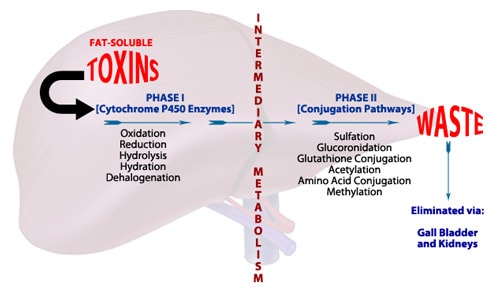
The liver is a crucial aspect of biotransformation of toxic compounds needed to be excreted.  It uses a two step enzymatic process in detoxifying.

Phase 1- the liver:
Step 1:
The first phase enzymes (cytochrome pathways) starts the biotransformation by turning fat soluble toxins into an intermediate toxin.  The problem is that this intermediate toxin is more hazardous to our bodies than the initial fat soluble toxin.

Step 2:
The second phase enzymes (conjugation pathways) finishes the job by taking hazardous intermediate toxin and turning into a water soluble toxin ready for phase 2 the excretion process.

Having a two step process leads to the potential of an imbalance.  Think of the liver as a factory with two conveyor belts.  If the first conveyor belt is creating garbage at rate greater than the second conveyor belt has the capacity to discard it, we are in some trouble!  If phase 1 enzymes are working faster than phase 2 enzymes you are creating a buildup of toxic intermediate byproducts that can react and damage DNA.
These liver enzymes can be positively and negatively influenced by factors like certain foods, drinks and hormones we consume or produce.  That means our diet can have an impact on the speed of these conveyor belts by either promoting a toxic intermediate build-up or promoting a synchronized balance.

Phase 2- the Gastrointestinal track and the kidneys:
Step 3:
The liver has now converted the toxins into a water soluble toxin ready for excretion into the kidneys and the gastrointestinal track via the gallbladder. Recent research has found that the receptors on the kidneys and gastrointestinal track, which allow the toxins to enter for excretion, are sensitive to pH. The physiology involved in this phase is quite complex, so here’s an analogy –The liver has transformed the garbage into a form (water soluble toxin) that is acceptable by the garbage truck in an environment (the right pH for excretion) that is acceptable by the garbage truck.  The garbage truck is now moving along your gastrointestinal track to the ‘dump’.  The difference is that in reality, your garbage truck is interacting with the billions of bacteria that exist in your digestive track.  If your garbage truck is too slow or the ratio of healthy to unhealthy bacteria living in your gastrointestinal track is off, some of your garbage may get transformed by the bacteria into a form your body can reabsorb!  That bacteria product would then need to travel trough the liver once again in order to be prepared for the dump yard.

Understanding the basics are an essential foundation in understanding how our actions can influence these pathways. Stay tuned for my next article on practical steps one can take to detoxify!

Filed Under: Detoxification

  • « Go to Previous Page
  • Page 1
  • Interim pages omitted …
  • Page 21
  • Page 22
  • Page 23
  • Page 24
  • Go to Next Page »

Footer

Phone:

604. 200. 7856

Address:

900-2025 Willingdon Ave, Burnaby (Brentwood), BC V5C 0J3

About Dr Melanie

Naturopathic Doctor offering consulting, specialty lab tests, professional grade supplements and dedicated wellness programs to BC residents via telemedicine, with offices in Burnaby – since 2010.

Let’s socialize

  • Email
  • Facebook
  • Instagram
  • Twitter

Search Site:

Copyright © 2020 Dr Mélanie DesChâtelets ND : Naturopath Burnaby & Telemedicine BC · All Rights Reserved. Privacy & Legal

Manage Consent

Okay, the boring-but-honest part: we use cookies. The digital kind, not the snackable kind (I checked). They store and read a little info on your device to keep things running smoothly and to see how the site's working overall... sometimes including a unique ID. Say yes and it all runs nicely. Say no and that's completely fine... a few features might just get a touch awkward.

Functional Always active
The technical storage or access is strictly necessary for the legitimate purpose of enabling the use of a specific service explicitly requested by the subscriber or user, or for the sole purpose of carrying out the transmission of a communication over an electronic communications network.
Preferences
The technical storage or access is necessary for the legitimate purpose of storing preferences that are not requested by the subscriber or user.
Statistics
The technical storage or access that is used exclusively for statistical purposes. The technical storage or access that is used exclusively for anonymous statistical purposes. Without a subpoena, voluntary compliance on the part of your Internet Service Provider, or additional records from a third party, information stored or retrieved for this purpose alone cannot usually be used to identify you.
Marketing
The technical storage or access is required to create user profiles to send advertising, or to track the user on a website or across several websites for similar marketing purposes.
  • Manage options
  • Manage services
  • Manage {vendor_count} vendors
  • Read more about these purposes
View preferences
  • {title}
  • {title}
  • {title}